
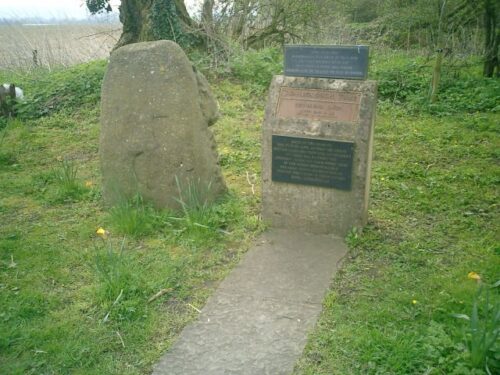
Swanborough Tump – Swinbeorg c850
In A.D. 871 the future King Alfred the Great and his elder brother King Aethelred I met there for an assembly of fighting men to respond to the Danes who were assailing Wessex from their base at Reading. Unsure if they would survive the campaign, they made an agreement that if one died, the survivor would provide land and inheritance for the deceased brother’s children – effectively acting as an early royal pact and will. This paved the way for Alfred’s accession later that year and his eventual shaping of the English kingdom.
This was also the meeting place of Hundred Moot of Swanborough in Saxon times. The word tump refers to a small hill and Swanborough Tump (recorded as Swana beorh, meaning “barrow of the peasants” in a 987 AD charter) served as the central open-air assembly point (moot) for the Swanborough Hundred. Local representatives gathered here annually to debate regional administration, settle disputes, and issue local laws.
A hundred is an ancient administrative, military and judicial division of a shire or a county in England – intermediate in size between a parish and a county. First appearing in Anglo-Saxon laws in the 10th century, a hundred was traditionally defined as an area large enough to sustain roughly 100 households or an area notionally comprising 100 hides of land.
Use of the site persisted through the medieval and early modern periods. By the 17th century, Michaelmas courts were routinely held at the Tump (sometimes locally referred to as Swanborough Ash due to the trees crowning the mound).
The Tump, which is in the parish of Manningford Abbots, is just to the south of the Pewsey to Woodborough road and to the east of Frith Copse.
As a millennium project the Parish Council cleared the undergrowth, left the fine ash trees and installed a sarsen stone with a plaque commemorating the history of the Tump. Swanborough was the name of the hundred, containing several modern villages and although it does not seem to have been used for a settlement it has given rise to the surname ‘Swanborough’.