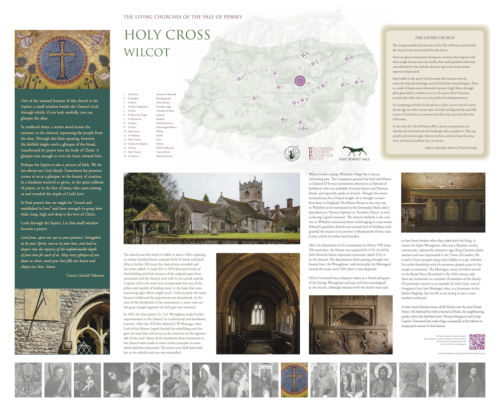

The church was first built of rubble in about 1200, replacing an earlier thatched Saxon example built of wattle and daub. After a further 200 years the chancel was extended and the tower added. A major fire in 1876 destroyed much of this building and little remains of the original apart from memorials and the chancel arch with its six carved capitals. A squint (still to be seen) was incorporated into one of the pillars and capable of holding water in the hope that some interesting light effects might result. Unfortunately the water became turbid and the experiment was abandoned. At the time of the dissolution of the monasteries, a stone cross on the grass triangle opposite the lych gate was removed.
In 1825, the then patron Lt. Col. Wroughton made further improvements to the chancel ‘in a substantial and handsome manner’. After the 1876 fire Admiral J W Montagu, then Lord of the Manor, largely funded the rebuilding and also gave the land that still serves as the cemetery on the opposite side of the road. Many of the handsome brass memorials in the chancel were made to relace earlier examples in stone which had been destroyed. The tower once held three bells but at the rebuild only one was reinstalled.
Wilcot is now a sleepy Wiltshire village but it has an interesting past. The Conqueror granted the land and Manor to Edward D’Evreux (sometimes referred to as Edward of Salisbury) who was probably of mixed Saxon and Norman blood, and reputedly spoke no French. Though this seems extraordinary for a French knight, he is thought to have been born in England. His Manor House is the only one in Wiltshire to be mentioned in the Domesday Book and is described as a ‘Domus Optima’ or ‘Excellent House’ as well as having ‘a good vineyard’. The church similarly is the only one in Wiltshire mentioned there as belonging to a lay tenant.
Edward’s grandson Patrick was created Earl of Salisbury and granted the manor in its entirety to Bradenstoke Priory, near Calne, which his father had founded. After the dissolution of the monasteries by Henry VIII some 350 years later, the Manor was acquired for £722 11s 6d by John Berwick whose impressive memorial, dated 1574, is in the chancel. His descendants (after passing through two female lines, the Wroughtons and eventually the Montagus) owned the estate until 1919 when it was dispersed.
Oliver Cromwell was a frequent visitor as a friend and guest of Sir George Wroughton and may well have worshipped at the church, although relations with the family were said to have been broken when they sided with the King. A cousin Sir Gyles Wroughton, who was a Royalist cavalry commander, adamantly refused to sign King Charles’s death warrant and was imprisoned in the Tower of London. He is said to have escaped using a key hidden in a pie: whether his earlier friendship with the protector played a part in his escape is unknown. The Montagus, many of whom served in the Royal Navy, flourished in the 19th century and there are memorials to a number of members of the family.
Of particular interest is an example for John Gore, son of Geogiana Gore (née Montagu) who, as a lieutenant in his father’s flagship, lost his life at sea trying to save a man washed overboard. A more recent famous owner of the Manor was the actor David Niven. His beloved first wife is buried at Huish, the neighbouring parish, where she had been born. Princess Margaret and Group Captain Townsend also took refuge occasionally at the Manor to escape press interest in their liaison.