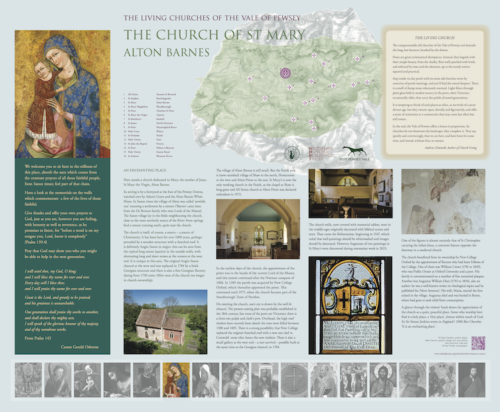

AN ENCHANTING PLACE
Here stands a church dedicated to Mary, the mother of Jesus: St Mary the Virgin, Alton Barnes.
Its setting is by a farmyard at the foot of the Pewsey Downs, watched over by Adam’s Grave and the Alton Barnes White Horse. In Saxon times the village of Alton was called ‘aewielle tun’ meaning a settlement by a stream (‘Barnes’ came later, from the De Berners family who were Lords of the Manor). The Saxon village lay in the fields neighbouring the church, close to the most northerly source of the River Avon: springs feed a stream running south, quite near the church.
The church is itself, of course, a source – a source of Christianity. It has been here for over 1000 years, perhaps preceded by a wooden structure with a thatched roof. It is definitely Anglo-Saxon in origin: this can be seen from the typical long stones (quoins) in the outside walls, with alternating long and short stones at the corners at the west end. It is unique to this area. The original Anglo-Saxon chancel at the west end was replaced in 1784 by a brick Georgian structure and there is also a fine Georgian Rectory dating from 1730 some 100m west of the church (no longer in church ownership).
The village of Alton Barnes is still small. But the Parish area is (now vanished) village of Shaw to the north, Honeystreet to the west and Alton Priors to the east. St Mary’s is now the only working church in the Parish, as the chapel at Shaw is long gone and All Saints church at Alton Priors was declared redundant in 1972.
In the earliest days of the church, the appointment of the priest was in the hands of the current Lord of the Manor, and this system continued after the Norman conquest of 1066. In 1385 the parish was acquired by New College Oxford, which thereafter appointed the priest. This continued until 1975, when the church became part of the Swanborough Team of Parishes.
On entering the church, one’s eye is drawn by the well-lit chancel. The present seating plan was probably established in the 18th century, but most of the pews are Victorian; there is a three-tier pulpit and clerk’s pew. Overhead, the high roof timbers have recently been dated: the trees were felled between 1380 and 1405. There is a strong possibility that New College replaced the original thatched roof with a new one clad in Cotswold stone tiles: hence the new timbers. There is also a small gallery at the west end – a rare survival – possibly built at the same time as the Georgian chancel, in 1784.
The church walls, now covered with memorial tablets, were in the middle-ages originally decorated with biblical scenes and texts. Then came the Reformation, beginning in 1547, which ruled that wall-paintings should be whitewashed and images should be destroyed. However, fragments of two paintings in St Mary’s were discovered during restoration work in 2023.
One of the figures is almost certainly that of St Christopher carrying the infant Jesus, a common feature opposite the doorway in a medieval church. The church benefitted from its ownership by New College Oxford by the appointment of Rectors who had been Fellows of the College. One of them was William Crowe (1745 to 1829), who was Public Orator at Oxford University and a poet. His family is commemorated on a number of fine memorial plaques. Another was Augustus William Hare (1792 to 1834), also an author: he was a well-known writer on theological topics and he published his ‘Alton Sermons’. His wife, Maria, started the first school in the village. Augustus died and was buried in Rome, where had gone to seek relief from consumption.
A glance through the visitors’ book shows the appreciation of the church as a quiet, peaceful place. Some who worship here find it a holy place, a ‘thin place’, almost within touch of God.
As Sir Simon Jenkins wrote in England’s 1000 Best Churches: ‘It is an enchanting place’.