
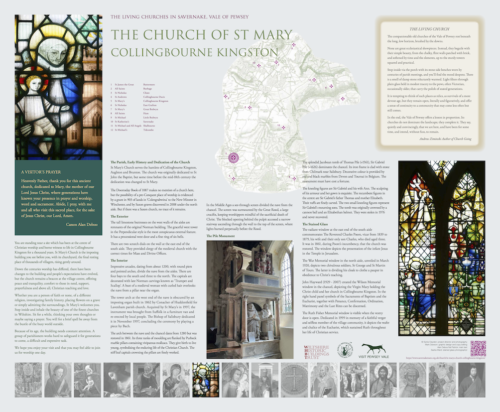
The Parish, Early History and Dedication of the Church St Mary’s Church serves the hamlets of Collingbourne Kingston, Aughton and Brunton. The church was originally dedicated to St John the Baptist, but some time before the mid-18th century the dedication was changed to St Mary.
The Doomsday Book of 1087 makes no mention of a church here, but the possibility of a pre-Conquest place of worship is evidenced by a grant in 903 of lands in ‘Colengrabwina’ to the New Minster in Winchester, and by Saxon graves discovered in 2008 under the north aisle. But if there was a Saxon church, no trace of it remains.
The Exterior
The tall limestone buttresses on the west walls of the aisles are remnants of the original Norman building. The graceful west tower in the Perpendicular style is the most conspicuous external feature. It has a processional west door and a fine ring of six bells. There are two scratch dials on the wall at the east end of the south aisle. They provided clergy of the medieval church with the correct times for Mass and Divine Offices.
The Interior
Impressive arcades, dating from about 1200, with round piers and pointed arches, divide the nave from the aisles. There are four bays to the south and three to the north. The capitals are decorated with late Norman carvings known as ‘Trumpet and Scallop’. A bust of a medieval woman with curled hair overlooks the nave from a pillar near the organ. The tower arch at the west end of the nave is obscured by an imposing organ built in 1862 by Conacher of Huddersfield for Lavenham parish church. Acquired by St Mary’s in 1997, the instrument was brought from Suffolk in a furniture van and re-erected by local people. The Bishop of Salisbury dedicated it in November 1997, concluding the ceremony by playing a piece by Bach.
The arch between the nave and the chancel dates from 1280 but was restored in 1861. Its three ranks of moulding are flanked by Purbeck marble pillars containing viviparous molluscs. They give birth to live young, symbolising the enduring life of the Christian Church. The stiff leaf capitals crowning the pillars are finely worked.
In the Middle Ages a see-through screen divided the nave from the chancel. The screen was surmounted by the Great Rood, a large crucifix, keeping worshippers mindful of the sacrificial death of Christ. The blocked opening behind the pulpit accessed a narrow stairway ascending through the wall to the top of the screen, where lights burned perpetually before the Rood.
The splendid Jacobean tomb of Thomas Pile (+1561), Sir Gabriel Pile (+1626) dominates the chancel. Its iron frame is clad with stone from Chilmark near Salisbury. Decorative colour is provided by red and black marbles from Devon and Tournai in Belgium. The monument must have cost a fortune. The kneeling figures are Sir Gabriel and his wife Ann. The sculpting of his armour and her gown is exquisite. The recumbent figures in the centre are Sir Gabriel’s father Thomas and mother Elizabeth. Their ruffs are finely carved. The two small kneeling figures represent Sir Gabriel’s mourning sons. The tomb was originally crowned by a cannon ball and an Elizabethan helmet. They were stolen in 1976 and never recovered.
The Stained Glass
The radiant window at the east end of the south aisle commemorates The Reverend Charles Poore, vicar from 1839 to 1879, his wife and their only son Charles, who died aged three. It was in 1861, during Poore’s incumbency, that the church was restored. The window depicts the presentation of the infant Jesus in the Temple in Jerusalem. The War Memorial window in the north aisle, unveiled in March 1920, depicts two chivalrous soldiers, St George and St Martin of Tours. The latter is dividing his cloak to clothe a pauper in obedience to Christ’s teaching.
John Hayward (1929 – 2007) created the Wilson Memorial window in the chancel, depicting the Virgin Mary holding the Christ child and her church in Collingbourne Kingston. In the right hand panel symbols of the Sacraments of Baptism and the Eucharist, together with Penance, Confirmation, Ordination, Matrimony and the Last Rites can be discerned.
The Ruth Fisher Memorial window is visible when the vestry door is open. Dedicated in 1999 in memory of a faithful verger and selfless member of the village community, it depicts the wafer and chalice of the Eucharist, which sustained Ruth throughout her life of Christian service.