‘My Dad & Me’
Our four-day break on a narrowboat on the Kennet & Avon Canal
Written by Steve from Berkshire
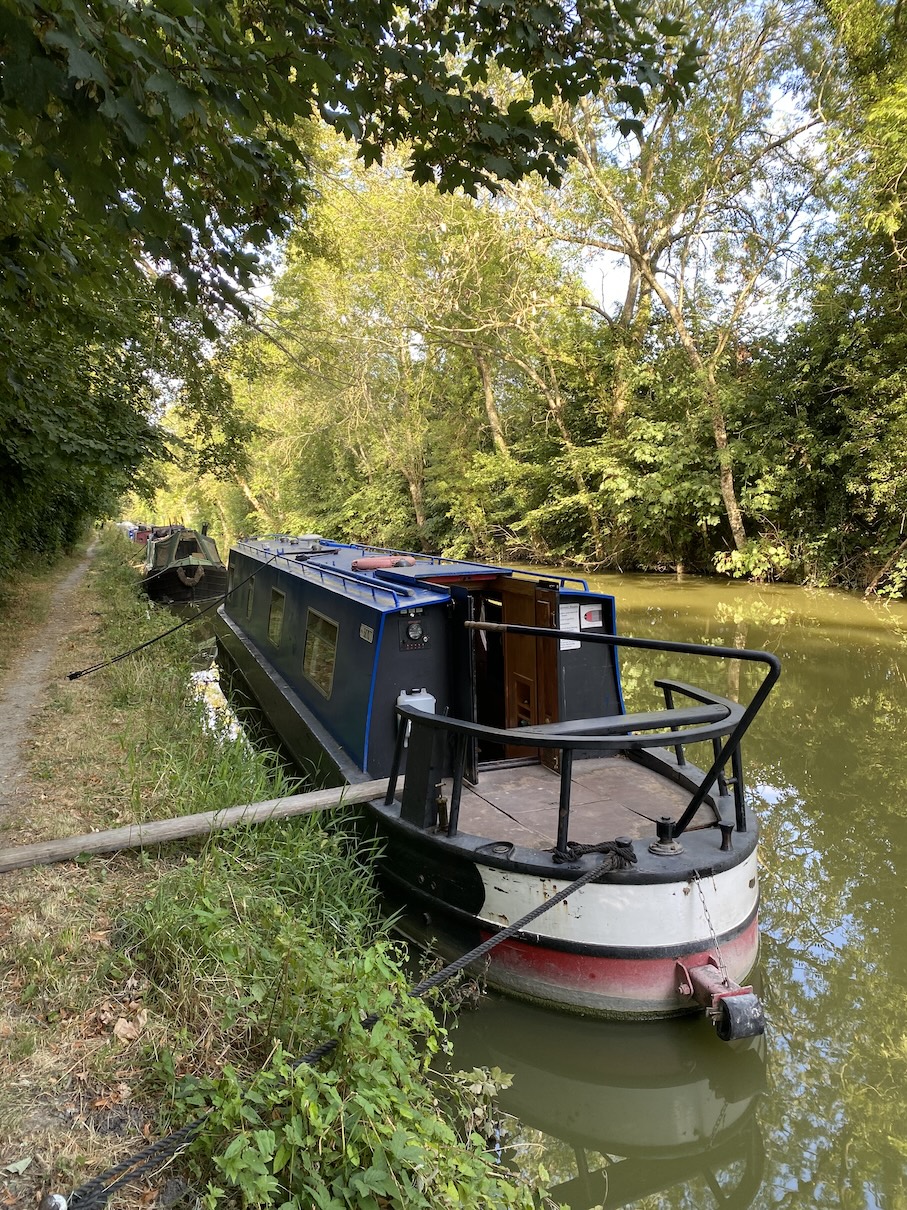
Honeybelle, our 45 foot long, slim-shouldered floating home
Day 1 – ‘Canals & Parrots’
Honeystreet Mill to Wilcot (3 miles, 0 locks)
Temperature: 26 degrees celsius
If it weren’t for the road crossing a sharply hump-backed bridge over the canal, it would be easy to miss the entrance to the lip-smackingly named Honeystreet Mill.
The gentle ebb & flow of visitors are presented with a ramshackle collection of rustic, agricultural looking barns and outbuildings, a mash of rust-red oxidised steel beams, weathered breeze block and distressed timber, which look to be held together as much by the glue of local community spirit, as they are by conventional bolts and mortar.
The convention shrugging theme continues with the discovery that this unlikely clot of cowsheds is home to a close-knit and mutually supportive cooperative of four cottage industries: The Honeystreet Mill Café and Farm Shop, Honeystreet Boats, The India Shop and The Crop Circle Exhibition and Visitor Centre.
The entrance is so unassuming it almost implies an intent to actually deter visitors, or at least, the type of visitor that might be incongruously ‘mainstream’, or rather distastefully, ‘in some kind of hurry’. Honeystreet Mill is guarded by a large, derelict house that looks as if it has been gutted by fire, but for the absence of a single charred timber beam or joist. It is as if the wood, windows, doors and entire contents had all been sucked away by a huge extraterrestrial hoover in the dead of night, leaving behind only an emotionally scarred skeleton of bone-white painted bricks.
We inch the car down the narrow, weed strewn driveway which leads to a large area of concrete hardstanding that serves as the car park for Honeystreet Boats, our first port of call.
Climbing out of the air-conditioned car into the torrid hug of that remarkable summer’s fifth heatwave, we look about for John, the owner.
Squat, wooden barrels broad enough to carry Bilbo and his companions line the water’s edge, bursting not with dwarves, but multi-coloured petunias. To one side is a small garden shed used as the boat company’s operations centre, overflowing with cleaning materials, cloths, rags, mooring ropes chewed thin by time, and different coloured unravelled hosepipes criss-crossing the floor like a rainbow of giant’s spaghetti.
The smiling John duly appears, a well-spoken, understated, salt and pepper haired fifty something, with a manner somewhere between laid back loafer and country squire. He shows us onto Honeybelle, our 45 foot long, slim-shouldered floating home for the week, whilst bestowing on us the knowledge that he had lived for many years on both narrowboats and wide beams (a narrowboat’s 10 or 12 feet wide bigger brother), in his (no doubt) colourful youth.
After a pleasantly unofficial briefing on narrowboat living and cruising delivered in a straightforward
“…press this to drain the shower tray,”
“…turn this to grease the crankshaft”
kind of way, and after lugging our few clothes and ridiculously over-zealous amount of food and drink aboard, we soon find ourselves waving John goodbye and easing away from the jetty with the reassuring ‘chug chug chug’ of the diesel engine issuing puffs of pewter smoke to the clear blue sky.
Taking it in turns to steer, and having safely negotiated two narrow bridges, several weeping willows and a cluster of unflustered ducks, we discover that a novice captain’s confidence can be built quickly at an average speed of 3 miles an hour. Standing on the ‘semi-trad’ stern which allows plenty of room for the two of us to move around the swan’s neck of a tiller without permanent genital damage, we soon settle into a relaxing and comfortable cruising routine that is both soporific in the heat, and constantly demanding of attention. If either of us take our eyes off the front of the boat for a moment (say, to glance at the map, or snatch a bite of sarnie), we would look up to find the prow heading into the bank. Keeping the boat in the middle of the canal where possible, with small, regular tiller corrections just either side of straight ahead seems to be the order of the day, rather than a panicked haul full rudder to correct a momentary lapse in concentration, which takes a long distance to smooth out.
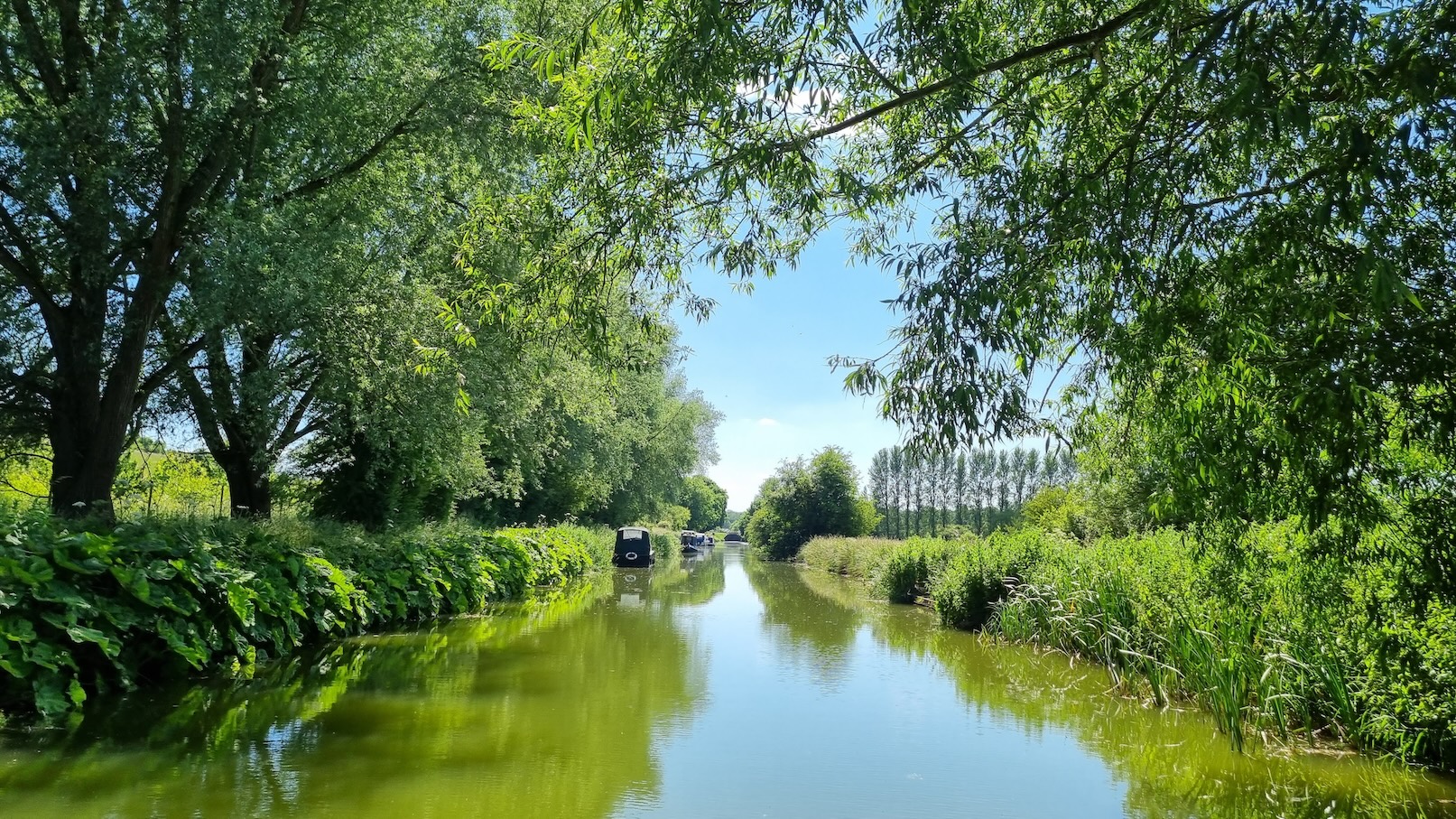
The canal is at one moment a dark, caramel brown, which reminds me of Oompah Loompas stirring the chocolate river. And the next, with a subtle shift of light, morphs into a deep, shimmering, peacock-feather green. Often the weave and wind of the canal offer up mirages: the water seemingly a definite dead end of trees and vegetation on the near horizon, until we chug a little closer and a watery bend to the left or right is gradually revealed.
Having set off at 2pm, after only a couple of hours of this relaxing, beautiful, slowly scrolling screen of nature, we reach the village of Wilcot, our mooring stop for the first night. We spot a space far enough ahead and big enough to accommodate our level of skill (so easily enough to fit two narrowboats and a barge), and manage to pull to the side with only minor bumping of steel bow against bank.
Jumping carefully ‘ashore’, the rough mooring ropes set about cutting into the pillow soft flesh of my palms, making me feel distinctly un-rugged, and simultaneously emasculated by mental images of deep sea trawlermen with hands of wet leather, hauling nets in the swell and freezing salt spray of a mid-Atlantic winter’s storm. But after many experiments with knots, lasso the boat to the bank we do, and to our surprise and satisfaction it stays put, more or less where it is told.
My 80-year-old father is understandably a little nervous of the distance from boat to bank, but luckily, we notice a scaffold plank stowed along the roof for use as a makeshift, trusty gangplank.
Following a canal map rather than satnav is a liberatingly simple exercise, which necessitates locating where you have moored up relative to the nearest land-based landmark (like a bridge), and then simply charting the course from your boat to the local pub. One tip: after the pub, find your way back to your boat before dark, if access from the bankside is at all challenging. You may find your moorings have loosened slightly, presumably due to the boat’s laudable but doomed attempt to follow you for a pint, making embarkation more of a challenge than exiting the boat hours earlier when sober.
The ten-minute stroll to The Golden Swan is ideal. Only one car passes us (already an exotic sighting after a day on the water) and we walk past many pretty thatched cottages with tiny, leaded windows, a red phone box turned micro-library, and a village green (which, despite the heatwave is still defiantly green).
The pub’s choice of ales is reassuringly rural, the price of its food a reminder that although we feel worlds away from twin brothers hustle and bustle, we are in fact still only an hour’s train ride from London. We order food and find a table in the garden to sup our pints in the now bearable afterglow of an almost setting sun.
Despite the Soho price, my cod and chips (is it really cod? No matter), and Dad’s ham, egg and chips are delicious, and very welcome after our first day’s slow-paced exertions.
Steering a chunk of fish mouthwards, I do a double take as a bright green parrot with a comically lop-sided gait wobbles onto the pathway behind us.
“Is that a parrot?” I ask. Dad throws me an expression suggesting I am pulling his leg, before turning round to confirm I am not having sun stroke induced hallucinations.
As the bird stops on the path beside us and cocks its head to one side, I can see that its peculiar walk is due to one oversized claw being far larger than the other. Not that the parrot seems to mind. Dad, having decided that its quizzical expression translates to, “give us a chip,” checks if they’re cool enough not to burn a parrot’s throat, before tossing a couple into its path. The parrot plays with one in its beak, drops it, picks it up and shakes its head violently from side to side to break the chip in two, then gulps the pieces in an unhurried, overly well-fed fashion. Only now I spot that he is a parrot with a beer belly, ‘chip-belly’ perhaps, or both. He looks a happy parrot, and why wouldn’t he be? I imagine he has given up a life on a narrowboat for preferable lodgings offering perks only a parrot can fully appreciate: plentiful scratches behind the ear, a perch that doesn’t rock, and even the occasional porky scratching.
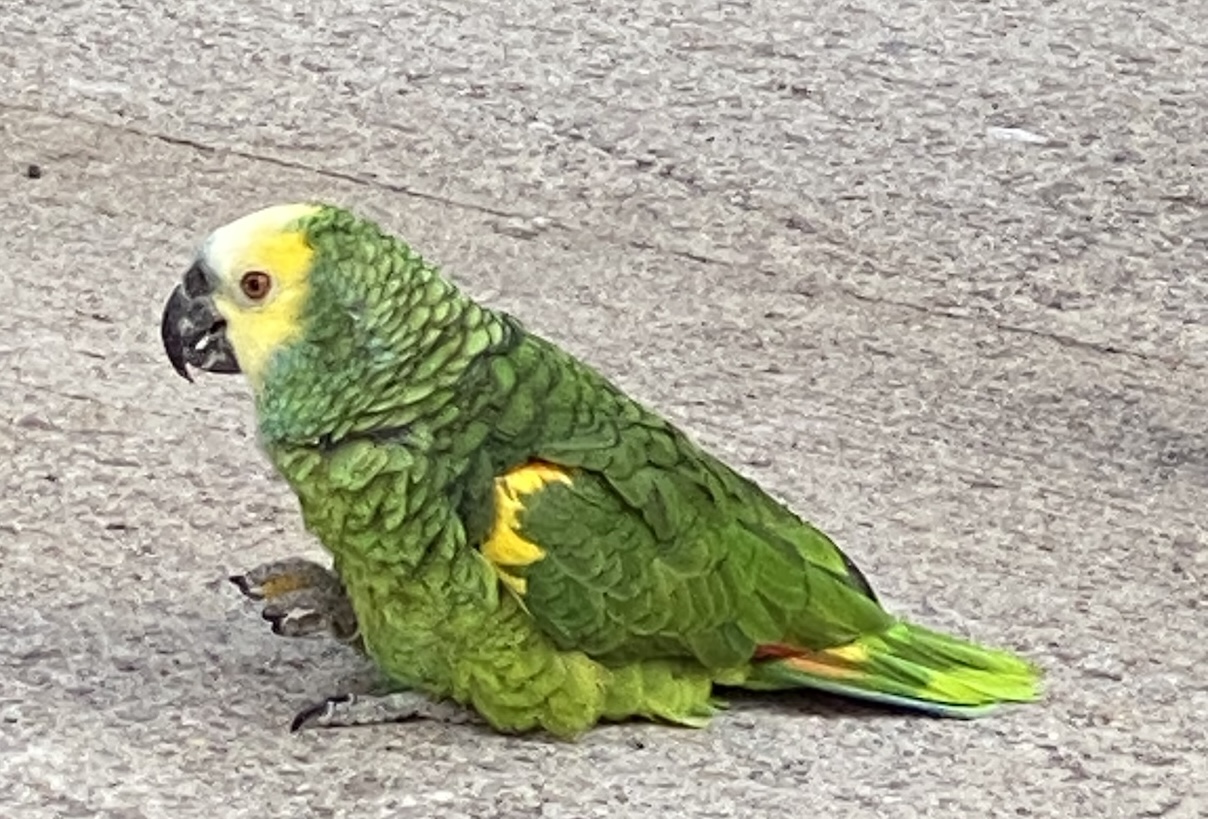
The chip-bellied parrot
Day 2 – ‘Locks & Locks of People’
Wilcot to Crofton (7 miles, 4 locks, 1 tunnel)
Temperature: 28 degrees celsius
One of the uncertainties in my mind before going on a narrowboat holiday was wondering how well I would sleep. Would the bed be long enough? Would the movement of the boat keep me awake? Would the smell of the toilet give me nightmares? It turns out I needn’t have worried on most counts. At 6’3’’ I only need to lie very slightly diagonally, as one might in a campervan, but with no loss of comfort. I don’t notice the boat rocking at all, as no other boats go past at night and there isn’t a breath of wind, and as for the loo…well, here’s the thing.
Honeybelle, like many narrowboats, is fitted with a ‘pump out’ loo, which sounds great, in principle. Because we are only on the boat for less than a week, and assuming it had been emptied during the previous changeover, this would be an ultra-convenient ‘flush and forget’ arrangement for us. But reality proved a little different. I’m not sure I will ever forget the toenail curling, noxious, downright evil odour coming from beneath the little plastic flap at the bottom of the pan. With the flap closed – stand up or sit down, do your business without a care in the world – job’s a good ‘un. But do not under any circumstances press the foot pump that opens the flap (to allow your business into the underslung tank and flush with water), unless you are fully prepared for the stench emitted, and are suitably equipped with nose clip, snorkel and scuba mask, copy of The Bible…etc. By Day Two I had been forced into the habit of leaving the flush until last in my order of ablutions, then pressing the foot pedal before hurling myself out of the door and slamming it closed behind me, with the terrified yelp of a fox pursued by hungry hounds.
Flushed with confidence after a successful Day One, we head off from Wilcot in fine spirits, the sun climbing through bankside trees, casting a merry dance of sparkling light and dappled shade across the water.
Part of the spectacle on a narrowboat holiday comes from passing all the other boats on the water. When we went (at the height of summer), much of the traffic is day boaters and holiday boaters, with the far more sensible and experienced ‘liveaboards’ moored up in all the shady spots available. The difference between a liveaboard boat and a holiday boat is quickly obvious. Liveaboard boats have: logs, kindling and branches on the roof, more logs often stored beneath solar panels, along with bags of coal, barbecue-sized gas bottles, potted plants, potted herbs, potted trees, shrubs and bushes. In fact, many liveaboard boats appear more plant than boat, with much of the cabin covered in assorted vegetation. They also tend to have far more comfortable seating arrangements at prow and stern than holiday boats, with sofas, hammocks, fishermen’s chairs and haphazard arrangements of fairy lights ready to provide extra evening ambience. These boats have delightful and sometimes unexpected names like Bird of Paradise or Zulu No.2.
By mid-morning Honeybelle is chugging past Pewsey Wharf and we reach our first lock. Due to his senior years and prior experience, we agree that Dad should captain Honeybelle through the locks, whilst I operate the paddles and gates. Here we enjoy the company of other boaters, and after naively hogging the first lock all to ourselves, learn that many locks are designed to fit two narrowboats, snugly side by side, like two cigars in a sock.
Our first lock companions are a holidaying husband and wife with teenage daughter. The mum steers the boat while I benefit from the husband’s advice, having confided to him that this is my ‘virgin’ lock. All goes well and I can see that lock duties are certainly better when shared, which makes me appreciate the heavy work that solo boaters must face when regularly negotiating locks, and how pleased they must be to have some help. The boating community seems very relaxed and friendly, with the holiday boaters and liveaboards co-existing quite happily, albeit regarding each other from the wholly different perspectives of muggle and magical worlds.
That evening, having failed the first test of narrow boating at the second time of asking and managed not to moor up within walking distance of a pub, I am forced to fire up the hob and cook us some pasta and sauce. Standing at arms-length to stir the pasta with a wooden spoon, I can feel the extra throbbing layers of heat radiating along my arm, being careful not to allow the dripping sweat from my armpits to fall into the sauce. Cooking on a gas stove in plus 30-degree heat on a floating tin can of a narrowboat is about as masochistic as an Eskimo with hypothermia opting for an ice bath.
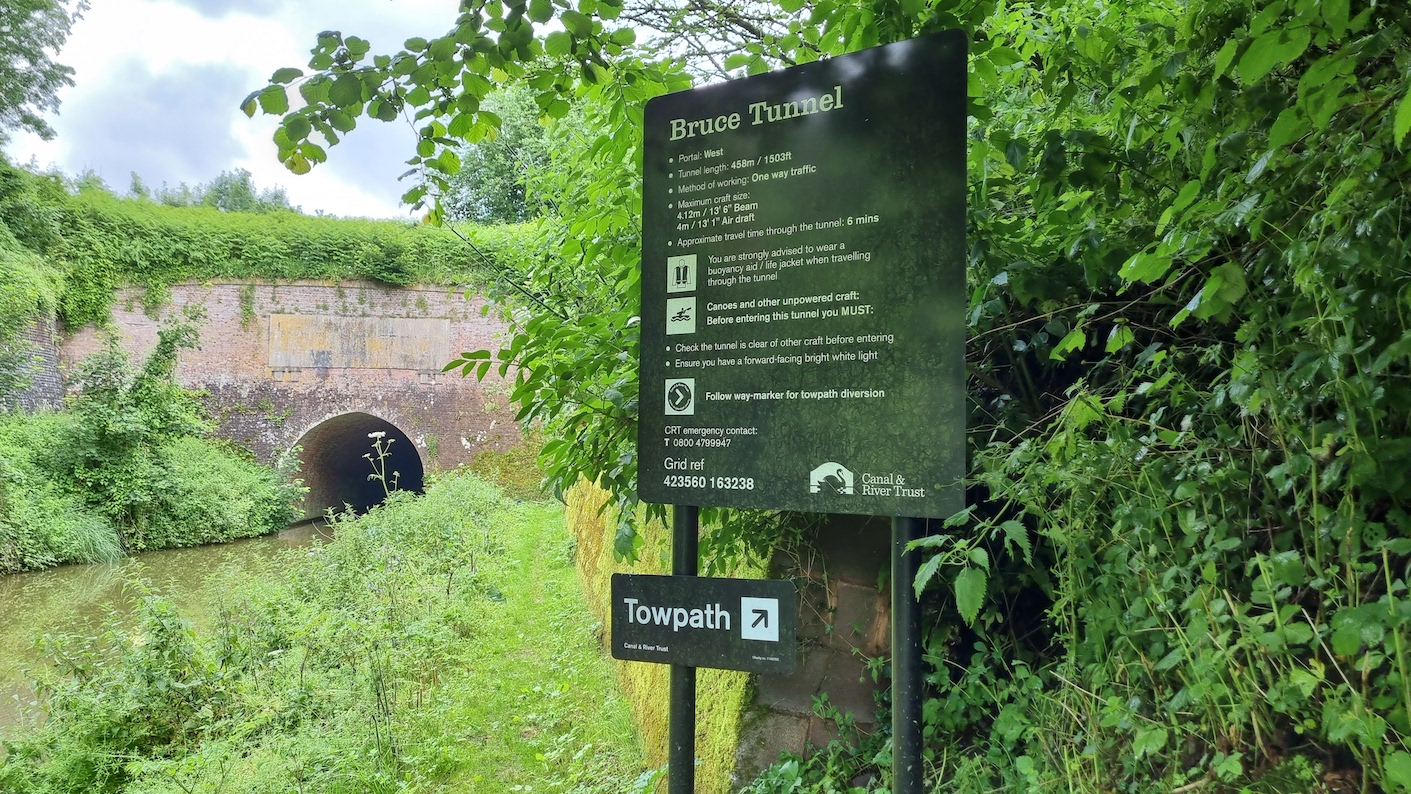
Bruce Tunnel
Day 3 – ‘Sunburnt Umbrellas’
Crofton to Honeystreet (10 miles, 4 locks, 1 Tunnel)
Temperature: 32 degrees celsius
By Day 3, our clock has become the sun, our compass the canal. Without wi-fi, the only genuine need for smartphones is laid bare; to message family. Every other function is exposed as spurious by the gently lapping necessities of narrowboat life. I find it very soothing how easily I can cope without obsessively tapping on various apps dozens of times a day. In fact, by the shimmering light of the canal, such behaviour is revealed for what of course it is – artificial, unnatural and addictive.
There is only one tunnel (Bruce Tunnel) on our route, which John had explained should be approached carefully with a long blast of the horn, to determine whether or not a boat is entering from the other side. The day before we had struggled with reversing Honeybelle when faced with a boat already in the tunnel on approach, resulting in the stressful situation of our boat being crossways in the canal as the oncoming boat emerged. The best way around this we discovered (if you are not skilled enough to reverse a narrowboat, which is not achievable by beginners, or certainly, not beginners like us), was to go forwards, get the boat in the desired line, then try to reverse back in a straight line.
Struggling to keep my heart rate near tickover, Honeybelle’s chugging engine begins to echo and boom around us as we enter the gloom of the tunnel’s throat. After the bright heat of the sun outside, the contrast inside this water-filled, claustrophobic, low brick arch is unsettling. There is a dank, stale, deathly smell that makes me look towards the small pin prick of light far ahead that seems to get no larger for several minutes, whilst the light of day behind us shrinks to almost nothing as we travel deeper inside. I did not expect to affected by this subterranean slice of time, struck by the fear of another boat entering the tunnel ahead and rendering us stuck, with our inability to reverse, and I find myself relieved, as we emerge once more, blinking into the fierce heat of the day.
The week before our holiday, there had been some ill-timed news stories about certain stretches of certain canals being closed due to the drought and resulting low water levels. I had shrugged this off as sensationalist news media, not prepared to let anything beyond our control dampen our holiday spirits in advance.
But as we leave the memory of the tunnel behind and approach the first lock of the day, we find that (although John had naturally sought to downplay the rumours), there is indeed some truth to them.
The locks along our stretch of the Kennett & Avon are only open between 10 am and 2 pm, in order to manage and preserve the dwindling ‘feeder’ reservoir water levels. A lock keeper tells me that the drought of 2026 is ‘the worst he can remember’, and if it hadn’t been for the heavy rains in the first few months of the year, the summertime canal would be ‘in trouble.’
Said lock keeper opens the sluice gates in the upper part of the lock, allowing the lock to fill, then, without letting any boats inside, opens the lower gates to release the water and raise the water levels in the lower part of the canal. He does this twice, and, looking on from our place at the front of the lock queue, we enquire how long it will be before the locks are re-opened to boats. He tells us that two narrowboats had moored up on the lower side of the lock the night before, only to find themselves grounded this morning, hence the reason for ‘flushing’ water through the system in an attempt to free them.
This proves successful – the skills of the lock keeper duly assured – and we are soon chugging on our way, only to run aground ourselves whilst pulling in to the side to wait before the very next lock. Thankfully we have travelled just far enough around a bend to be out of view of the lock keeper who had just warned us of the very same dangers.
Dad and I really think we are stuck here. I have visions of phoning the Canal & River Trust and waiting for hours and hours for a tug to come and pull the greenback holiday boaters free. No amount of pushing with a pole against the bank whilst easing Honeybelle backwards and forwards has any effect.
She won’t budge.
In the end, a desperate shunt of the throttle into full ahead makes the engine roar as we have not heard before, accompanied by a plume of black smoke coughed up by the chimney, a muffled scrunching of gravel against propeller beneath the water and we are set free.
At the queue for the next lock, I get chatting to a couple of friendly liveaboards with a bouncy black labrador that tirelessly fetches the stick I throw and drops it expectantly at my feet, tail thrashing. The owner, a man with tell-tale wild eyes and a bushy beard one could easily hide a bird’s nest in, seems pleased to be relieved of stick throwing duties momentarily, and is warning his colleague – a clean-shaven man with a tattoo of the chakras down his throat and a wooden hoop through his earlobe big enough to put a finger through – of the dangers of going into town to stock up on supplies due to ‘all the madness going on out there’. If the ‘town’ in question is anything like the village Dad & I had dinner in last night, I reason that the ‘madness’ of which he speaks is either a commotion over shifted Summer Fete dates, or a stir caused by someone new to the local Women’s Institute deviating dangerously from the established ingredients for Victoria Sponge. Still, I have to consider that perhaps I am not entirely attuned to the perils of a brush with neo-capitalist, conditioned society, from the objective viewpoint of the liveaboard community.
Nonetheless, I move on with the happily imparted knowledge that my new T-shirt – which I purchased from The India Shop in Honeystreet on a previous visit a few months prior – is a very rare five petalled lotus leaf, which is having the effect of cleansing my negative bodily energies, simply through the act of wearing. I thank my new friends for this positive affirmation, and am left with the feel-good glow of having got far greater value for money than I had realised from the £14.99 spent, as it is time to tend to my lock duties once more, which I now carry out in a wholly refreshed, positively glowing headspace.
We chug on all day and can’t find a mooring spot at Pewsey or Wilcot, resulting in a blisteringly hot, eight-hour cruise eventually bringing us all the way back to Honeystreet, where John looks surprised to see us pulling in to moor up a day early. Finally, we can put our umbrellas down and escape the ‘hot tin roof’ of Honeybelle. After a cool shower and change of clothes, we take the 10-minute stroll along the towpath to the famous Barge Inn.
Having watched dozens of crop circle related videos, I have seen The Barge Inn shot from all sorts of different perspectives by camera-folk of vastly varying ability, so I think I have a pretty accurate mental image of the place. This pub, music festival, wedding venue and alternative traveller / boater community hub delights by being far creatively richer, more imaginative, quirkier, off-beat and left field than anything my YouTube inspired imagination was able to conjure.
This feeling of the mystical and wonderful is enhanced by the full solar eclipse which begins to darken the skies as we eat our dinner in the canal side garden. My mind spins with borrowed images from the ceiling mural inside the bar, of UFOs causing crop circles in the shadow of Stonehenge and aliens walking among the wheat.
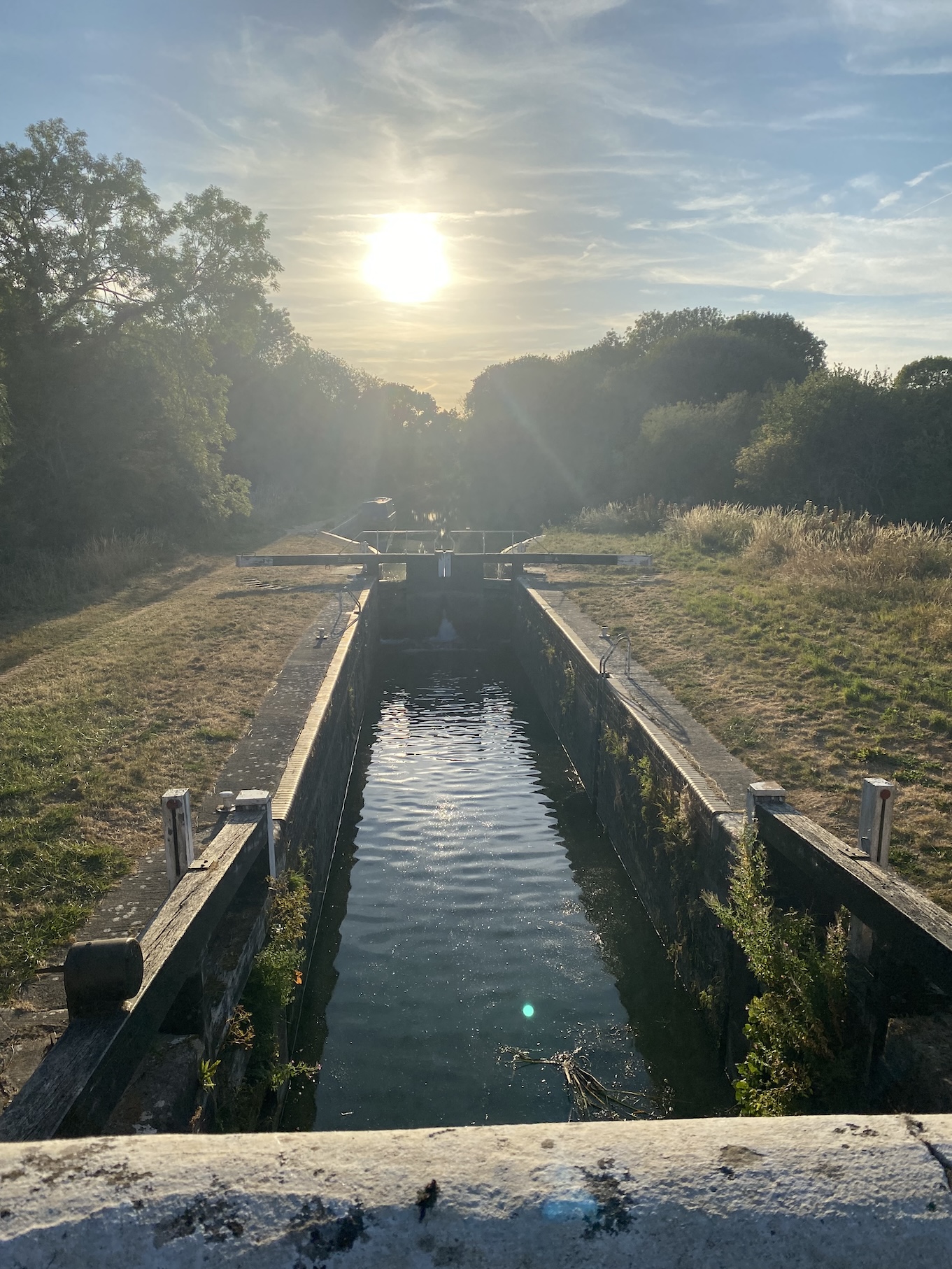
Lock at sunset
Day 4 – ‘A Conspiracy of Paddleboarding Dogs’
Honeystreet Mill
Temperature: 35 degrees celsius
Too hot. Just too damn hot by far. This is England, and something really must be done about it.
I wake early and sit at the duck hatch in my bedroom, tearing off chunks of stale bread to throw for the twin families of ducks and swans that have gathered as surely as if a dinner bell were rung. A couple astride a paddleboard move slowly by the boat, smiling their good mornings. A labrador stands proudly, excitedly between them in its life jacket – ears back, tail straight – its owners possessing some powerful, invisible mind control over their canine friend, stopping him from leaping into the water after the nearby birds.
In The Honeystreet Mill Café, I sit with sweat trickling down my spine, marking out a miniature, ephemeral canal route on my skin as I wait for my full English breakfast to arrive. I am relieved that we are not out cruising again today, the air of relief between Dad and me is as palpable as the whiff of hot fat & grilled bacon wafting from the kitchens. We remark on how kitchen staff are lucky to have air con, but working conditions must still be uncomfortably sticky. In this heat, everything is in some way about the weather.
Wiltshire’s Vale of Pewsey is a global epicentre for crop circles, as well as having far more than its fair share of ley lines and standing stones. Something must be going on in the relationship between the three, I can’t help wondering. But part of the enduring appeal of crop circles is that they have never been satisfactorily or definitively explained, and many mystical, mythical and weird and wonderful theories abound about their possible origins, purpose and meaning. They attract a cross-section of interest from around the world, from highly qualified, committed rational scientists, through conspiracy theory types, to unhinged, esoteric hippies. I suppose I fall somewhere in the middle, being a believer in the alien-origin story, whilst also scoffing at the wide-eyed, mushroom gulping folk tales of world leaders all being evil alien abductees.
Although – it would explain a lot.
If anything, I think the beauty of crop circles alone betrays benevolent origins. A coded solution perhaps to the energy crisis, hushed up by the fat wallets of petrochemical giants. Whatever the truth, I have learned that only 4% of crop circles are proven to be of human origin. The rest, impossible to create in the few darkest hours of a summertime night, on uneven terrain, often wet and muddy, without leaving a trace. Geophysical and geochemical alterations to both crops and soil in the crop circle areas show powerful electromagnetic, heat or sound wave related activity, producing perfect geometrical patterns of mind-boggling scale and complexity, that can only be appreciated by an aerial view, and could never be made on the ground.
Whatever the truth, for anyone not conditioned beyond curiosity or blinkered by denial, I would thoroughly recommend a visit to Monique Klinkenbergh’s lifelong obsession made real in this sleepy Wiltshire hamlet. A place in time where life moves at a refreshingly leisurely pace, and nothing of note appears to happen, except in the small hours, among the golden swaying wheat fields, while humanity is dreaming dreams it will not recall come morning – washed clean from consciousness, just as a crop circle is harvested – only to revisit us as a ghosts – pale, shadowy reminders of forgotten, former glories.
Our thanks to Steve for his wonderful story of his and his dad’s adventure on the Kennet & Avon Canal in the Vale of Pewsey.
You can hire a day (or evening) boat or enjoy a longer stay with Honeystreet Boats at Honeystreet Mill. Alternatively, for accessible boats, you can hire day or longer adventures with Bruce Boats who are at Bedwyn Wharf in Great Bedwyn.